[Thoughts on the Table – 78] A Chat with Award-winning Author Andrew Cotto

Andrew Cotto is an award-winning American writer of Italian descent. His latest novel titled Cucina Tipica tells the fascinating adventure of a young American who falls in love with Tuscany and with the culture of its people. Naturally, food and wine end up setting the pace and become deeply entrenched in the story.

I was humbled to be contacted by Mr. Cotto who sent me a copy of the book for consideration as he thought it would fit with the theme of the podcast. After reading it, I couldn’t agree more! Please join us in this episode where we discuss the novel in its many aspects–from the significance of food in the Italian culture to the chemistry of taste, from culture shock and relocation to speaking a foreign language and what it does to interactions and introspection.

You can follow Andrew Cotto on andrewcotto.com as well as on Twitter, Facebook, and Instagram. Cucina Tipica is available on Amazon.


As an “appetizer” for the book, Andrew sent me a recap in the form of a Food and Wine Plot Menu with 24 tastes each corresponding to a food scene in the novel. Enjoy!

Cucina Tipica: An Italian Adventure
A Novel by Andrew Cotto

Food & Wine Plot Menu

Food and Wine Plot Menu

Novel Overview: Cucina Tipica is the story of a disheartened American who arrives in Italy on holiday and decides he never wants to leave. What follows is a wine-soaked, food-filled travel adventure about one man’s quest for an antiquated existence in the modern world.

Characters:
Jacoby Pines – a forlorn young American with a “golden palate” and hopes of redemption in Italy
Claire – a travel writer and Jacoby’s fiancee
Bill – a septuagenarian ex-pat from Texas and Jacoby’s wingman in the “adventure”
Paolo – Jacoby and Claire’s neighbor and landlord in the hills south of Florence near the village of Antella
Dolores – Claire’s “outrageous” English cousin and “Chiantishire” resident
Helen – An Aussie/English ex-pat and Florence museum guide

1st Taste:
Who: Jacoby and Claire
Where: Excelsior Palace Hotel – Rapallo, Italy
Food: Prosciutto, cheese, olives, dried lemons, fresh figs
Wine: Prosecco
Additional Notes: They ate with their hands and drank from the bottle, leaving stains and crumbs on the bed sheets, which Claire attempted to clear before removing her bikini bottom…

2nd Taste:
Who: Jacoby and Claire
Where: A “hole-in-the-wall” seafood osteria in Rapallo
Food: a basket of lightly fried calamari, shrimp, bream and whole anchovy seasoned with salt and lemon; pureed and garlicky fish soup; steamed prawns dipped in aioli; grilled sardines; plates of pasta with pesto and plates of pasta with clams
Wine: Carafes of Vermentino
Additional Notes: They shared the meal of seafood by the seaside in the Rapallo back alley as completely as possible, holding hands under and above the table, kissing frequently, filling each other’s glasses, and laughing throughout the two hours of slow and utter indulgence.

3rd Taste:
Who: Jacoby and Paolo
Where: The terrace behind Paolo’s villa featuring a wood-burning oven
Food: Handmade pizza with olives, anchovy fillets, and fresh basil; “Misto Arrosto” – a mixed roast of lamb, sausage, rabbit, liver in caul fat, guinea hen, halved-potatoes, heads of garlic, caramelized carrot and fennel.
Wine: “Local Chianti” – DOCG Colli Fiorentini, Grappa
Additional Notes: Jacoby felt as peaceful and inspired as he had in months. Maybe ever. The best two meals of his life had been had over the first two days in Italy. The country itself was more beautiful than pictures could capture. The people spoke a lovely language and wore elegant clothes. It was all good. And he wanted in.

4th Taste:
Who: Jacoby and Claire
Where: Comune di Norcia (Umbria)
Food: Porchetta sandwich for Jacoby; salad of wilted wild mushrooms atop bitter local greens for Claire
Drinks: Soft

5th Taste:
Who: Jacoby and Claire
Where: An elegant agriturismo in Le Marche
Food: Charcuterie plate of house-cured meats; silky thick noodles topped with black truffles; lamb roast; Pecorino cheese drizzled with honey
Wine: Rosso Piceno
Additional Notes: After dinner, they roamed the silent grounds and made love on a pool-side chaise lounge after skinny dipping in the cool water that rippled with shards of silver moonlight.

6th Taste:
Who: Jacoby and Claire
Where: The tiny piazza in Panzano-in-Chianti
Wine: Brunello di Montalcino
Additional Notes: Claire tucked into Jacoby’s side and put a foot up on the bench against the back of her leg. They silently swirled the wine and took small sips, staring at the valley beyond the village that burned gold with smoldering sunshine of a fading afternoon. Jacoby savored the apple smell of Claire’s radiant hair and the feel of her lithe body pressed into his. He thought that they, in that still pose, would make a great statue, like a modern Apollo and Daphne, frozen in marble so that their love would always last.

7th Taste:
Who: Jacoby, Claire, Dolores
Where: Restaurant in Panzano owned by a young butcher (inspired by the auspices of Dario Cecchini)
Food: Bistecca Fiorentina, uccellini in brodo (white beans with tomatoes in broth)
Wine: Vecchie Terre di Montefili – Chianti Classico
Additional Notes: The flavor of the beef was as profound and complex as any Jacoby had ever tasted. Steak in the States was bland, in need of sauce, but this simply-prepared choice cut was perfectly grilled – seared on the outside, rare and warm internally – helped by hints of lemon and rosemary and coarse salt while letting the flavor of the meat itself dominate. Amazing. Transcendental. Good f****** lord.

8th Taste:
Who: Jacoby, Claire, Dolores
Where: Terrace behind the barn where they lived on Paolo’s property
Food: Eggs with prosciutto and sage, bread
Wine: Prosecco
Additional Notes: Jacoby loved cooking for people, then sharing the meal and the mutual pleasure of being together. Eating the same food; drinking the same wine; everyone on the same stage. It was like sex when sex was good and mutual. What people called “making love.”

9th Taste:
Who: Jacoby, Claire, Dolores
Where: Mercato Centrale, Florence
Food: Margherita Pizza
Wine: Moralino di Scansano

10th Taste:
Who: Jacoby and Bill
Where: Hotel Floria-Zanobini, Antella
Food: Sausage and eggs with stewed tomatoes
Drink: Espresso
Additional Notes: “I’ve been an ex-pat for 35 years, and the only thing I miss about America is breakfast,” – Bill

11th Taste:
Who: Jacoby and Bill
Where: Hotel Floria-Zanobini
Food: Spring Minestrone (generous with pieces of artichoke, asparagus and carrots in a broth of pureed onions and leeks with a snap of garlic); fresh fettuccine with fava beans and Pecorino; rabbit loin wrapped in pancetta over polenta dotted with green olives
Drinks: Negroni, Chianti Colli Fiorentini, Grappa
Additional Notes: Bill and Jacoby ate and drank and spoke of their looming adventure into Florence proper, in search of a matriarch holed up in a palace marked by a cat statue. They laughed at their dim prospects, which were soothed by the magnificent meal and flowing wine.

12th Taste:
Who: Jacoby and Bill
Where: Florence, food stand near the Sant’Ambrogio market
Food: Lampredotto sandwiches
Wine: Chianti in plastic cups
Additional Notes: The aroma out of the stand was pungent; the sandwich warm in his hand, of tomato infused broth and hearty filling tucked between the bread. The taste was super savory to the bite, ample aromatics and a soft texture from the holy trinity of bread and filling and broth.

13th Taste:
Who: Jacoby, Bill, Helen
Where: Florence, a gazebo in Piazza Signoria
Wine: Prosecco
Additional Notes: “Why, yes. Yes, I would,” Helen said. “There’s few things I prefer more than a glass of Prosecco.”

14th Taste:
Who: Jacoby, Bill, Helen
Where: Florence, Il Teatro del Sale
Food: Gurguglione; artichoke sformato; polpettini; fried rabbit; zucchini stuffed with ground pork; roasted chicken & sausage with potatoes, flourless chocolate cake
Wine: House red, Vino Nobile di Montepulciano
Additional Notes: There was nowhere else in the world Jacoby wished to be. This was his Grand Canyon. His Hawaii. Mount Everest or Disney World. His paradise was a theater-cafeteria-commissary, sharing a table with two people he hardly knew but liked immensely, full of possibilities, in a room full of shamelessly happy people.

15th Taste:
Who: Jacoby, Bill, Helen
Where: Florence, club Sriracha
Drinks: Negronis (many)

16th Taste:
Who: Jacoby
Where: The barn
Food: Steak & eggs
Additional Notes: Tears fell down Jacoby’s face as he continued to chew enough to swallow safely. The salt from the tears entering his mouth brightened the flavor, making it more clear what was happening even before Claire descended the stairs in the same clothes she wore before, a suitcase thumping beside her.

17th Taste:
Who: Jacoby
Where: Al fresco table at the cafe in Antella
Food: Ceci and bread
Wine: Chianti Colli Fiorentini
Additional Notes: “Ciao,” Jacoby called before tucking into his plate of oven-baked chickpeas that tasted as flavorful as anything he’d ever eaten, washing the legumes and bread down with the local red wine as he sat in the cool shadows of his own private dining terrace on a Friday night in a silent village as twilight settled upon him in what felt like the most important place in all of the world.

18th Taste:
Who: Jacoby
Where: Osteria in Pienza
Food: Pici with porcini; pappardelle with wild rabbit ragu
Wine: Argiano Vino Nobile di Montepulciano
Additional Notes: In a shaded osteria at the end of town, Jacoby couldn’t decide between two pastas… so he ordered both, taking the mushroom plate first, followed by the gamy second course, both washed down with separate, massive goblets of Vino Nobile, which he swirled and sipped with great delight.

19th Taste:
Who: Jacoby
Where: Enoteca la Fortezza, Montalcino
Food: A plate of Pecorino in three varieties
Wine: Il Poggione Brunello di Montalcino (2007)
Additional Notes: When it was over, Jacoby felt a thread of sadness which he hoped to dash through the purchase of a case of the very wine he just drank.

20th Taste:
Who: Jacoby and Bill
Where: A cantinetta near Antella
Food: mixed antipasti; tagliatelle with porcini; roasted pork ribs; cantuccini…
Wine: Colli Fiorentini Riserva, …Vin Santo
Additional Notes: “That was incredible” Jacoby said. Bill made a face of modest expression and flicked a wrist in the air. “Cucina tipica,” he said.

21st Taste:
Who: Jacoby and Helen
Where: Lo Sprone Vinaino, Santo Spirito, Florence
Food: Cacio e Pepe; charred octopus & potatoes; roasted pigeon
Wine: Martinis (in the piazza out front), white wine (unnamed)

22nd Taste:
Who: Jacoby
Where: Hotel Floria-Zanobini
Food: Cinghiale ragu over polenta
Wine: Il Poggione Brunello di Montalcino
Additional Notes: The meat was as tender as it was flavorful, filling his mouth with silky decadence buttressed by layers of flavor only attainable through days of preparation that precedes slow, slow cooking.

23rd Taste:
Who: Claire & Dolores
Where: Hotel Floria-Zanobini
Food: Cinghiale ragu over polenta
Wine: Il Poggione Brunello di Montalcino
Additional Notes: “My f****** God!” Dolores’ voice shot from the kitchen. “This is the best thing I’ve ever tasted in my life!”
Jacoby and Claire cracked up and parted their hug.
“Bring it in here,” Jacoby called.
“No f****** way!” Dolores called back.

24th Taste (in absentia):
Who: Jacoby, Claire, Dolores, Bill
Where: The cantinetta near Antella
Food: To be determined
Wine: To be determined (lots guaranteed)
Additional Notes: “How’s the food?” Dolores asked Jacoby. “Decent?”
“Oh, it’s way better than decent,” Jacoby said. “More like typical.”

END OF NOVEL.

Mascarpone Cream – How to Make Panettone Divine

Growing up in the province of Milan, the presence of various panettoni in the house was reliably the earliest indicator that the Christmas season had returned. My father would receive a couple of panettoni as a gift from his workplace, my mother would bring one or two home she received from some the people she visited as a nurse, and my grandmas would always give us some of the ones they received since they couldn’t eat them all. Occasionally, right before Christmas, my family would also order an artisan-made panettone from their favorite local pastry shop.
Given the abundance of the seasonal sweet-bread, my family consumed panettone straight out of the box as dessert, afternoon snack, and even as breakfast. But after Sundays meals, and for sure on Christmas day, we used to serve panettone accompanied with something that made it even better: mascarpone cream and a glass of spumante!

What follows is the recipe that my grandmother passed down to my mother, who then passed it down to me. It’s quite simple to make, but it involves a certain amount of hand whisking. This preparation is what my family also uses to make tiramisù.

Mascarpone Cream

Yield: 10 servings

Total Time: 20 minutes

Prep Time: 20 minutes

2 tablespoons per serving

Mascarpone Cream

Ingredients

  • 500 g fresh mascarpone
  • 5 of the freshest eggs
  • 5 tablespoons of sugar
  • 2 tablespoons of rum

Preparation

  1. Take the eggs and the mascarpone out of the fridge an hour ahead of time so that they reach room temperature.
  2. Soften the mascarpone by stirring it energetically for one minute in a bowl.
  3. Whisk together egg yolks and sugar until the mixture becomes smooth and lighter in color.
  4. Stir in a tablespoon of mascarpone into the egg mix. Continue stirring until no lumps are left, and the cream begins to thicken.
  5. One tablespoon at a time, incorporate the rest of the mascarpone.
  6. Beat the egg whites until very firm, then gradually incorporate 2/3 of them into the cream (discard the rest), mixing gently from the bottom up in a circular motion.
  7. Slowly stir in the rum, mixing until fully absorbed.
  8. Just before serving the panettone, ladle a generous tablespoon of mascarpone cream over each slice and enjoy!

https://www.disgracesonthemenu.com/2016/12/mascarpone-cream.html

[Thoughts on the Table Transcript] Frank Fariello from Memorie di Angelina

Back in March 2014, I had the pleasure of having Frank Fariello (Memorie di Angelina) on a podcast. In the episode, we discussed the differences between Italian-American cooking and the food of Italy, a topic on which Frank is remarkably insightful, being a third generation Italian-American who lived in Rome for 10 years.

This post presents the same interview in textual form as an enjoyable read, and as a searchable reference.


Listen to the original episode


Paolo Rigiroli
Hello, and welcome to the audioblog. Paolo here again for another episode. Today I have a special guest with me, Frank Fariello from the fantastic blog, Memorie di Angelina. Hi, Frank. Good morning.

Frank Fariello
Hey Paolo, how are you doing?

Paolo Rigiroli
Good. Thanks so much for accepting to connect with me. It’s an honor.

Frank Fariello
Oh, it’s my pleasure.

Paolo Rigiroli
Frank accepted to be interviewed, and I have prepared a lot of questions. I’m sure, like me, you’ll be very interested to know his answers. We want to know a lot more about you, Frank.

Frank Fariello
Uh oh…

Paolo Rigiroli
So let’s start from, of course, from you. Do you want to introduce yourself to our listeners?

Frank Fariello
Sure, why not? My name is Frank, as you know. I’ve got an Italian last name, Fariello. I am from New York originally. I was born in New York City actually, but lived in the suburban part of New York for most of my childhood. I am a lawyer by training and by profession, and still continue to practice law, but I’ve spent a great deal of my adult life outside of the United States. I actually took some time off [from the profession]. I was thinking about leaving the law at a certain point in my life. I had about ten years under my belt as a corporate lawyer in New York and was kind of tired of the rat race.

Paolo Rigiroli
I see.

Frank Fariello
So I took some time off. I was thinking about becoming a professional chef. Cooking has always been my passion. I went and lived for a few years in Paris. There are great hotel schools, as you probably know, in Switzerland, in the French speaking part of the country. So my plan was to go to France, perfect my French, and then go on to [the Hotel School in] Lausanne. As you know, that was [where] one of the great Italian chefs of the time… a Milanese, named Gualtiero Marchesi [had been trained].

Paolo Rigiroli
Oh yeah, of course. Super famous.

Frank Fariello
Do remember him? Very famous. A little bit controversial, I understand, among some Italians. They called him “Il Francese” because he had a certain different way of approaching Italian cooking, but I had studied his work and found him quite inspiring. I knew that he had gone to Lausanne, to the [hotel] school there and wanted to kind of follow in his footsteps.

Frank Fariello
In any event, [I never made it to Lausanne.] I was [in Paris] for a couple years, then lived in Vienna for a couple more years. At that point, I had returned to the practice of law. Some old colleagues from New York had convinced me to get back into the profession, and they were based in Vienna and Moscow, so I was doing some work there. Then, in about 1995, so this is going back a few years, I saw an ad in the paper for an international organization based on Rome. Of course, I’m an international lawyer by trade, [but my practice had been in private international law]. I had always been interested in [practicing public international law] in an international organization. I applied [for the job] and “only” 9 months later, I was hired. I went down there and spent 10 years living in Rome.

Paolo Rigiroli
In Rome, in the city.

Frank Fariello
Yeah. That was a fantastic thing. I had always kind of wanted to… It sounds like a cliché of course, but wanted to sort of discover my roots. Actually, my roots are not in Rome, they’re farther south in Campania and Puglia. But still, it was a great opportunity. So I took it.

Paolo Rigiroli
Very interesting that you were at one point pursuing the career of becoming a chef, and considered changing [job] entirely. You know, it takes a lot of courage to do that. I’m not surprised that you were pulled back…

Frank Fariello
Yeah, well it takes a lot of courage, and maybe that’s why I didn’t do it ultimately!

Paolo Rigiroli
Yeah, but you did do something else. You started writing this blog that has become the most popular blog about Italian food today. So it is a fantastic achievement, and it obviously speaks to the quality of your work. I’m not surprised to see that your interest went as far as to bring you to Paris. So that really makes a lot of sense now.

Frank Fariello
Yeah. Thanks. Yeah, it is a great… That’s one of the great things about the blog. It allows me to enjoy the [culinary] world without, of course, the back breaking work and the horrendous hours of actually being a restaurateur.

Paolo Rigiroli
I see. Well, I’m sure it takes up a lot of time anyway, but certainly it is a different activity. Yes, I can see that. So when did you start Memorie di Angelina?

Frank Fariello
Well, it actually started out when I joined Facebook.

Paolo Rigiroli
Oh.

Frank Fariello
I didn’t set out to be a blogger, to be honest. I joined Facebook and, like a lot of people on Facebook, I started discovering old friends from high school and college and law school and all the rest of it. I decided I wanted to share some recipes with my friends, so I started posting recipes to my profile. That was a lot of fun and people were enjoying the recipes, but I was frustrated by the platform. It wasn’t really as flexible as I wanted it to be, so I cast around [for ideas] and decided to start a blog. Just for my friends, initially. That was the only ambition I had was to continue sharing those recipes, but to do it in a way that was easier to get the point across. And… the rest is history. The blog got some attention and, next thing I know, 5 years later I’m still blogging!

Paolo Rigiroli
Yes, and thank you for that. It’s a great resource for me as a cook, and of course a great point of reference (that I often quote) to talk about what I talk about, which is authenticity and Italian food of Italy today, which is something that has become sort of my battle – so to speak – to try and fix Italian food in North America. As you know, my battle is against the type of Italian-American food that is not advertised as such. I have respect for Italian-American cuisine, but I really think it should be called for what it is. I’m all for certification as well to try and, whenever possible, certify Italian food – continental Italian food of Italy today – as such. And I applaud any kind of certification like Pizza Verace, which is a great association based in Naples that certifies around the world, and Tuscanicious, which by the way you were just recently awarded. Congratulations.

Frank Fariello
Yes. Well thank you. That was a tremendous honor for me. It’s a great validation of the work I’m doing… My blog is about Italian cooking of all kinds, not really focused on Tuscan cooking in particular, so the award was, in a sense, a surprise. But a wonderful one.

Paolo Rigiroli
Yeah, it is a great honor, and you deserve so much. So yeah, authenticity is important, but I also find that many of those self-proclaimed Italian restaurants simply serve food that is just plain bad food. That is really sad to me. I really think that there is such thing as good food and bad food in general, and in fact a lot of my friends who actually have been to Italy told me that they really liked the real Italian food so much better. Which may signify that there is an absolute value to flavor. I don’t know how you feel about that.

Frank Fariello
I certainly agree. All kinds of cooking can be good, and I enjoy all different kinds of cooking. But I firmly believe there is such a thing as good food and bad food. Even as a kid, I remember comparing the Italian food that you might have in a restaurant with the food that my grandmother made, and I knew liked my grandmother’s food a lot better! To some extent, Italian food is a victim of its own popularity. And unfortunately restaurateurs-some of them who should know better, others who perhaps don’t-take advantage of that popularity to frankly make a buck on the cheap. I hate to put it that harshly, but I think in some cases that’s what it is.

Paolo Rigiroli
It’s marketing.

Frank Fariello
Yeah.

Paolo Rigiroli
Following a popular trend. When you say “Italian,” it seems to sell more. Right now they’re starting to say “Tuscan” or you know, “Sicilian,” trying to go down to the region which makes it [sound] even more authentic.

Frank Fariello
Yes, indeed. I don’t know if you know Nicoletta Tavella – she’s a fellow blogger. She also has a cooking school in Amsterdam, and I heard an interview with her with an Italian radio or TV… I can’t remember which. She was talking about some of the funny products that they sell in Holland, like “Tuscan pesto”, whatever that might be! So this is not just North America where this kind of thing happens. As you say, “Tuscan” has that caché. Never mind that there is no such thing as Tuscan pesto. But anyway…

Paolo Rigiroli
So Frank, speaking of authentic food, I would like to go back a little bit to your grandmother. Because you’re a third generation Italian-American, but yet you seem to have such a precise image of Italian food. Yours is not distorted at all. I’m Italian born and raised there. I spent my first 30 years there. I read you… I really cannot detect any difference in how I would describe it. You just describe it better than I would. It’s true.

Frank Fariello
That’s very kind of you to say. I think I have two advantages maybe over other Americans or other foreigners who are pursuing [the study of Italian cuisine]. One is I actually grew up with Italian cooking. My grandmother is the reason why my blog is called the way it is. It’s a tribute to her, because she really imprinted those flavors on my palate, if I can put it that way.

Paolo Rigiroli
That’s a good way [to put it].

Frank Fariello
At a very tender age, it’s so natural. She was special because she did not [compromise on authenticity]. Of course, she was first generation, and there’s a big difference as the generations proceed, in terms of assimilation and adaptation. She made her dishes just as she learned them growing up in Italy, in that small town in Campania. I verified that when I went to Italy and ate those same dishes, some of which I didn’t realize existed outside of my grandmother’s kitchen, by the way. I was almost shocked to see them on menus, in store windows. I remember once, it was around Christmas time, and we went down to the Amalfi coast for a vacation to get away from Rome for a bit, and I looked in a pastry shop window and found my grandmother’s honey balls: Truffoli! I had no idea they actually existed other than as an invention my grandmother had made. But she recreated all of those things, and quite well, I think, given what she had to work with. Of course she had to make some compromises, because not all ingredients were available in the US, especially back in those days. The other thing, of course, is that I spent 10 years living in Italy. That’s irreplaceable, too.

Paolo Rigiroli
Yes.

Frank Fariello
You know, getting to know Italian cooking, especially Rome because that’s where I was. But I liked to travel a lot, all throughout the country. And being a foodie, the first thing I wanted to do was try the local dishes. I used to ask people, “What should I try?” and “How do you make this?” And I’m an avid collector of cookbooks.

Paolo Rigiroli
Oh, I see.

Frank Fariello
Anywhere I went, I always bought a little local cookbook to find out what the local dishes were and try to recreate them when I get home and all of that.

Paolo Rigiroli
Yeah, and I love how you put these cookbooks as reference in your blog posts whenever you can, because… you can quote them, and use the collective knowledge that they accumulated into themselves. So we were talking about adaptation and the fact that Italian food sometimes, as generations go by, changes. Evolves. Why do you think this is happening? Is it a matter of adapting to the local palate, or is it more the fact that the ingredients are not available, or that the ingredients are different?

Frank Fariello
That’s a good question. I think originally, of course, it was about availability of ingredients. I think if you look at first generation, Italian Americans in particular, that was a big thing. [And then some differences reflect an expression of the diaspora community.] I sometimes talk about Italian American cooking as a sort of celebration of plenty. This is immigrant cooking, so it was made by people who came from very humble backgrounds. Certainly in my family that was the case. [They celebrated] the fact that they now could afford to have meat any time they wanted. So Sunday dinners were often kind of “meat fests”: We’d have the pasta dish, dressed with Neapolitan ragu`, with sausages and beef and all these other things… And then yet another meat course would come after that, usually roast chicken or something of this kind. So it’s a lot about just kind of enjoying the fact you can afford to have all of this food that perhaps back home you couldn’t. That’s of course the first generation.

Frank Fariello
I think the second generation is a bit different. And I saw this also, by the way, in reverse when I was living in Italy. Children of immigrants put a huge premium on fitting in and assimilating, and feeling that they were part of the country they were born in. Sometimes even almost in opposition to their parents’ generation.

Paolo Rigiroli
Oh yeah.

Frank Fariello
You’ve seen this probably–

Paolo Rigiroli
I have seen this. I know a lot of Italians. They have Italian last names so I approach them in the workplace, and often they actually… reject their origins. They don’t speak Italian, pretty much by choice. Yeah. It’s strange, but in a way, it’s assimilation. It is forcing yourself to stop being typecast, because I suppose it happens.

Frank Fariello
Absolutely. I think that that goes for the cooking as well, and eating habits and the rest. You kind of, you want to be kind of more American than the Americans.

Paolo Rigiroli
Right.

Frank Fariello
Of course, when you try to go back and recreate the dishes, that’s going to have an influence. And then there’s the third generation… I’m third generation – I think there’s a bifurcation here, because there’s some, like myself, who kind of want to recapture something.

Paolo Rigiroli
Mm-hmm (affirmative).

Frank Fariello
Then there are others who just kind of keep on going and proceed with further Americanization, to the point where basically, other than the name, they are more or less indistinguishable from any other Americans.

Paolo Rigiroli
Yeah, absolutely. The problem is that some of them own a restaurant…

Frank Fariello
Yeah. Yes. That’s when things go awry!

Paolo Rigiroli
I saw this thing just yesterday. We were in this Italian café, I’m not going to say the name, and they had “Italian burgers”, okay? (You don’t see Frank, but he’s shocked!) With a side of pasta, of course (!) And I really like the place, actually. I go back there because they make really good omelettes, actually. They cook something that is not really an Italian dish, but they do it really well, and I really like them. But then they do these things… Just because they call themselves Italian, I think.

Frank Fariello
Yeah, that’s the marketing thing again. You sprinkle a little oregano on top of it or a little melted mozzarella or whatever, and suddenly it’s Italian this or that.

Paolo Rigiroli
Yeah, I know. What’s even worse is when you throw in ingredients that totally don’t fit in with a dish. You just posted today your carbonara, and you talk about cream as a common addition in North America, into carbonara. Obviously, that does not belong in the dish. It’s totally unnecessary, it changes it entirely. You know, in this case, the addition of ingredients is done in the attempt to… I don’t know, make the dish more rich. To make it more flavorful. I don’t know. What do you think?

Frank Fariello
Well… I think that’s often very true, and I agree about the cream. I think it actually, if anything, takes flavor away. But yeah, it’s probably meant to make the dish richer and more [appealing]. Again, this celebration of plenty that I talk about, and it can go a bit too far. It becomes almost an overdoing- extravagant. That’s true for example, in the use of herbs and spices and so on, which in fact is, as of course you know very well, not at all typical of good Italian cooking. Just the opposite. It’s all about discretion and balance.

Paolo Rigiroli
And balance. And I think, you know, the problem probably is that the fewer ingredients you have, the more they have to be right. They have to be flavorful, and they have to have the correct flavor. So maybe I’m thinking it could be that sometimes one adds more ingredients to try and compensate for the lack of flavor of local produce, which… wasn’t grown in the same sunny lands of Italy. I’m thinking tomatoes, as an example.

Frank Fariello
That’s the classic example, of course. It’s the bane of any Italians I talk to who come to the States, and I’m sure Canada is the same way… They always ask me: “Where are the good tomatoes?” It’s an endless search. Of course, you can find them if you go to a farmer’s market, but you have to really make an effort. The great thing about Italy is any old supermarket will offer you wonderful produce. Of course, it’s even better if you’re growing your own… I was very lucky because although I spent most of my stay in downtown Rome, for the last three years, we lived outside of town.

Paolo Rigiroli
I see.

Frank Fariello
In a kind of a rural area. I grew my own vegetables, my own tomatoes, my own zucchine. We even had hens, a hen house, and we got the eggs. If you’ve ever eaten eggs right from the hen, it’s just something incredible.

Paolo Rigiroli
And I have. My grandmother had eggs from her chickens. You’re right. It was incredible.

Frank Fariello
And we had peach trees, too. The peaches off the tree were something else. Of course, if you have a peach like that that’s dripping and sweet and lovely, you don’t need sugar on it. You don’t need anything on it. It’s just beautiful the way it is. I think you’re quite correct about how best quality ingredients makes lots of different extraneous flavors unnecessary. But if you don’t have that kind of quality ingredients, then of course, the temptation is to make up for it in other ways.

Paolo Rigiroli
Yeah. I can see that. Frank, I wanted to also talk a little more about you as a food blogger and the food blogging activity itself, and becoming as popular as you have become. The question that I have for you is, did popularity change you? Do you feel the pressure of having so many viewers to keep up and produce always more interesting [posts] and continue the volume of production?

Frank Fariello
Well, yes and no. I do try to blog once a week, [although lately I’ve been so busy it’s been more like once every two weeks]. I try to keep to that rhythm and not go beyond it, in part because I don’t want to raise expectations of people. In the middle of the week, or on off weeks, I will post old posts on my Facebook page. The great thing about cooking is, of course, nothing goes out of date. You can take a post from two years ago and send it out there, and people who haven’t seen it before will enjoy it. This posting schedule is realistic for me. I have a day job, like many bloggers. I kind of envy those who are dedicated full-time to the food business. That would be fantastic, but I’m not, so this is kind of a hobby for me. But I do try to stick to this schedule because I know that there are people who occasionally, if I slip, will send me messages like, “What happened? Where is this week’s installment?” Of course, I feel awfully guilty about that!

Paolo Rigiroli
I’m hungry. What happens?

Frank Fariello
Yeah. Right? But I try to keep it realistic. So you know, once a week is a realistic level [of commitment] for me.

Paolo Rigiroli
Mm-hmm (affirmative). Do you get a lot of requests? Do people ask you for a certain dish?

Frank Fariello
Yes. Yes. I do get requests from time to time. I try to put them on my list but I have a blog plan, so it can be a while until I get around to them. I’m trying to hit all the major dishes in the various regions. The vision I have for Memorie di Angelina is, more than a blog, as kind of an online cookbook.

Paolo Rigiroli
Mm-hmm (affirmative).

Frank Fariello
So I am trying to be, if not comprehensive-because that’s practically impossible when you’re talking about a subject as vast as this one-but as complete as I can make it over time. So I do have a plan that I’m following, and if a request falls well within the plan, I’ll do it. Occasionally, it’ll be a request for something that’s actually Italian-American rather than Italian. That’s the other thing.

Paolo Rigiroli
Right.

Frank Fariello
I keep those requests on the “back burner”, because once in a while, usually on Columbus Day, I do like to feature an Italian-American dish.

Paolo Rigiroli
So you have a plan. Do you think you can just go on forever, just because it’s such a vast world?

Frank Fariello
Yes. Well, forever, perhaps not. But I won’t live forever, either, unfortunately. I think it’ll be a while until I run out of [dishes to write about]. I don’t really need “ideas” in the sense that, unlike other bloggers, I don’t really try to do creative things too much. But occasionally, I’ll feature my own take on a classic dish. Dishes generally have lots of variations, especially the more famous ones, so I’ll express my preference.

Paolo Rigiroli
I see.

Frank Fariello
I bring that much of my own personality to the dish, but I try to be faithful to the classic recipes. That makes it easy in a way. I don’t feel the need to invent things.

Paolo Rigiroli
I see, I see, I see.

Frank Fariello
Of course the repertoire of Italian dishes is so enormous that it’ll be awhile until I run out of recipes.

Paolo Rigiroli
Which is really fantastic. I guess there are also many other ways to present your work. I saw you have a Flipboard, I think it’s called, now.

Frank Fariello
Yes. Yes, my Memorie di Angelina Flipboard has become quite popular. It’s really taken off, and I’m pleasantly surprised. It was kind of a lark. We had a snow day once, and I said, “Let me put one together.” And the response has been excellent.

Paolo Rigiroli
Fantastic. I saw it. It’s really nice. It’s like a digital cookbook, a recipe book. I love the format. It’s awesome. Yeah.

Frank Fariello
I’m quite pleased with it.

Paolo Rigiroli
Have you ever thought about publishing an actual book?

Frank Fariello
I get that question quite a bit. I guess my answer is I’d love to, but when would I possibly find the time? This is the thing. Again, having a day job makes it difficult. But if I ever feel like I can take a couple months off, sabbatical, maybe. Why not?

Paolo Rigiroli
Why not? Looking forward to that. I just want to end this interview – thanks so much, Frank, it was amazing, of course – with one last question about your time spent in Italy.

Frank Fariello
Mm-hmm (affirmative).

Paolo Rigiroli
If I were to ask you now, you’ve been back for a few years now, what do you miss the most?

Frank Fariello
Wow. That’s an interesting question. I guess, I mean… the food, I guess, would be one big thing. Probably the biggest, I mean, from the point of view of someone who is so obsessed with eating and food as I am. As we were talking about, the excellent quality of the raw ingredients you have to work with. It makes cooking so… In a way, almost too easy. You know?

Paolo Rigiroli
I know. I do know.

Frank Fariello
There’s so little you have to do to those ingredients to make them taste good. It’s fantastic. And beyond the food, of course the beauty of the country. And the warmth of the people. That’s a cliché, but I think it’s true. Well, Romans can be rough, too. But they’re always honest. I think the thing is that they may not always be polite, but they’re always themselves, and I appreciate that.

Paolo Rigiroli
Fantastic. Thanks, Frank. It was a great pleasure having you here. Well, we’ll keep in touch, and–

Frank Fariello
Absolutely.

Paolo Rigiroli
Maybe later on, we’ll have another chat together.

Frank Fariello
Look forward to it. Take care, now.

Paolo Rigiroli
Fantastic. Thanks so much again. Bye-bye.

Frank Fariello
Bye-bye.

[Thoughts on the Table – 36] Truffle Hunting in Abruzzo with Hannah Solomon from SZ Tartufi

Thoughts on the Table is back! Join me to meet Hannah Solomon, a marketing consultant who is doing an internship at SZ Tartufi, a company that produces truffles and truffle-based preparations in the Abruzzo region of Italy.

During the episode Hannah talks about the fascinating process of cultivating truffles, as well as the fact that the best truffles cannot be cultivated at all(!), but need to be hunted with the use of dogs (as co-founder Ugo Serafini shows in this truffle hunting video).

Hannah was also kind enough to send a small sample of their products – which of course I was super excited to try! Below you can find a delicious use of them, a recipe recommended by Hannah herself. Enjoy!

Music: www.purple-planet.com.


Truffle Crostini with Asparagus Tips and Poached Eggs

Ingredients for 2 servings

  • 2 tablespoons of White Truffle Cream
  • 10 small asparagus
  • 2 eggs (the freshest that you can find)
  • 2 thick slices of bread
  • One drizzle of Truffle Oil
  • 1 tablespoon white vinegar

Preparation

  1. Bring a large pot of water to a very gentle simmer, add the vinegar.
  2. Boil the asparagus for 5 minutes and set aside. Trim off the bottom part, only leaving the top 4 to 5 inches.
  3. Crack one egg into a small bowl, then slide it slowly into the water. Let the eggs sink to the bottom on one side of the pot. Repeat with the second egg making it land on the other side. Leave the eggs undisturbed for 4 to 5 minutes until the white feels solid.
  4. Meanwhile, toast the bread. Spread the White Truffle Cream on it, then lay the asparagus over top.
  5. Lift the eggs from the water with a slotted spoon to drain any excess liquid. Lay them over the asparagus.
  6. Drizzle the crostini with Truffle Oil, and enjoy!

Asparagi alla Milanese – The Incredible Pairing of Asparagus and Eggs

Of simple Italian recipes that are almost unknown outside of Italy, Milanese-style Asparagus would probably rank near the top. This dish, traditionally associated with the city of Milan, is enjoyed all around Italy as a second course, especially in late spring, when asparagus is in season.

Before getting to the recipe, let’s spend a few words on its main ingredient. Asparagus is one of the shoots of a perennial plant called Asparagus officinalis, harvested when it reaches a length of about 8 inches and hasn’t yet developed any branches. If allowed to grow, the shoots become inedible – they gradually thin out, harden, and develop fern-like branches, up to 1.5 meters tall. Indigenous of Eurasia, Asparagus officinalis was already known in ancient Egypt, when it was eaten raw. The Greeks and the Romans are credited for learning how to cultivate it and for discovering its diuretic properties.

In North America, asparagus is mostly used as an appetizer or as a side dish (steamed, fried, or char roasted), as well as in soups and quiches. In Italy, it is also used to make one kind of risotto, in ‘frittate’, as filling for ravioli or just paired up with melted butter, eggs, and Parmigiano as in this recipe.

Asparagi alla Milanese

Yield: 2 servings

Total Time: 15 minutes

Prep Time: 5 minutes

Cook Time: 10 minutes

Asparagi alla Milanese

Ingredients

  • 1 kg of fresh asparagus, washed and with their bases trimmed
  • 4 tablespoons of Parmigiano, freshly grated
  • 2 tablespoons of butter
  • 4 eggs
  • salt

Preparation

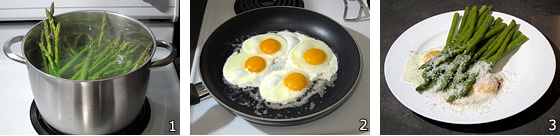
  1. Place the asparagus in a pot of salted boiling water, the spears above the waterline to be cooked by the steam. Cook for 10 minutes (15 if the stems are particularly thick). If using a large pot, the asparagus can be tied up to force them to remain vertical.
  2. Just before the asparagus are cooked, fry the eggs in butter, sunny-side-up, in a large non stick pan. Ensure the whites are fully firm, while the yolks are still runny.
  3. Gently drain the asparagus and assemble the dish in warm serving plates by layering the eggs, the asparagus (tips towards the center), and the grated Parmigiano.

https://www.disgracesonthemenu.com/2011/08/asparagi-alla-milanese.html


Insalata di Riso

‘Insalata di Riso’ (rice salad) is an informal Italian dish that is especially popular in the summer as an appetizer or as a refreshing first course, particularly for lunch. Its main component is Parboiled rice, which is the most appropriate for this preparation as its grains remain firm and separated when cooked, and stay soft when they get cold. The cooled rice is lightly dressed with olive oil and lemon juice and flavored with a variety of add-ins, according to personal preference, but also following the tradition.

Insalata di Riso

Yield: 3-4 servings

Total Time: 45 minutes

Prep Time: 45 minutes

Insalata di Riso

Ingredients

     Main

    • 1 cup parboiled rice
    • 2 eggs
    • 1 cup fresh or frozen peas
    • 100 g mild cheese (Fontina, Montasio, Raclette, Gouda), cubed
    • ½ cup Italian pickled cucumbers (no dill and no garlic!)
    • ½ cup Italian mixed 'sottaceti' (vinegar-preserved vegetables, e.g.: peppers, corn, capers, carrots, olives, fennel, artichokes)
    • ¼ cup sliced olives
    • 2 tablespoons of olive oil
    • the juice of 1 lemon
    • salt

     Other

    • pickled 'cipolline' (small onions), halved
    • pickled bell peppers, cut in small pieces
    • tuna in olive oil, crushed
    • ham, diced
    • cold roast beef or chicken, cut in small pieces

    Preparation

    1. Boil or steam the rice then spread it over a cloth and let it cool down, by the end the rice should be dry and fluffy.
    2. Meanwhile, hard boil the eggs and cook the peas, then let them also cool down.
    3. Move the rice into a bowl (fig. 1) and gently mix in the olive oil. Gather the pickled veggies (fig. 2).
    4. Gather peas, eggs (fig. 3) and diced cheese (fig. 4).
    5. Mix all of the add-ins together with the rice, then stir in the lemon juice.
    6. Adjust the salt and let the salad rest in the fridge for at least 1 hour.

    https://www.disgracesonthemenu.com/2011/08/insalata-di-riso.html

    Gelato vs. Ice Cream

    What is gelato?

    Gelato is not Italian for ice cream. In Italy, the word ‘gelato’ (plural: ‘gelati ‘, literally meaning ‘frozen’ and with nothing to do with gelatin) refers to a product that resembles ice cream, but that is technically quite different, especially in its artisan version.

    Gelato is based on a custard typically made with egg, sugar, and whole milk (though there is also a variation called ‘sorbetto’ that doesn’t contain dairies). The hot mix is then allowed to slowly cool off for the water to bind with the milk proteins and ultimately give smaller crystals when frozen. Real fruit, chocolate, nuts are then added as flavors. The freezing process happens in small batches in a mixer, and this incorporates air increasing the volume by 25-30%. Gelato should be stored at a temperature between -10 and -15 °C and consumed within a few days.

    Ice cream is usually made with half cream and half milk, normally through a cold mix process. The production lines work in air to double the product’s volume. Ice cream is stored at a temperature around -20 and -25 °C and can last for a few months.

    What makes gelato authentic?

    What is served as ‘gelato’ is not likely to be authentic if:

    • Too sweet. Italian gelato gains its flavor from being denser, slightly warmer, and from containing natural, high-quality ingredients, not just sugar. The flavors are generally quite simple (see below) – in Italy, you will find no marshmallows, peanut butter, Oreos, Reese’s and -please!- nothing savory.
    • Served too cold. Authentic gelato is preserved at a less cold temperature to preserve its creaminess – if the store has too many flavors for what they can sell daily, this is a sign that the product is not freshly made and is deep-frozen to extend its fridge life.
    • Containing too much fat. Artisan gelato would be completely solid in a deep freezer. If the product is still partly soft, this is a sign of higher fat content (if you get a chance to see it melt, gelato melts quickly turning into a milky drink, ice cream instead slowly separates into a thick foam and a watery runoff).

    What is gelato to the Italians?

    So, now that we know how to differentiate ice cream (or bad gelato imitations) from authentic gelato, let’s talk about what gelato really is for the Italians.

    Gelato is a dessert, a refreshment, a summer treat, and even a small meal. The main place to get gelato is in a ‘gelateria’ (gelato parlor). Gelaterie are very common all throughout Italy, but especially in those cities where it gets particularly hot during the summer. During winter, the ones that stay open often only have limited flavors, or even alternatives such as ‘gelato caldo’ (warm gelato, a relatively new invention which is more of a mousse) or just whipped cream (with cocoa or cinnamon powder). Gelaterie serve gelato to go either in individual portions (in cones or disposable cups), or larger quantities in insulated containers (priced by the liter and considerably cheaper than the equivalent amount bought in individual portions; in some cases empty cones are also available, complimentary or for a fee). More elaborate preparations are sometimes offered, usually intended for sit-down customers (compositions with wafers or biscuits, melted chocolate, whipped cream). Gelaterie, as well as most pastry shops, also may offer ‘semifreddi’ (gelato cakes), and, like many cafés, also use gelato as the base for ‘frullati’ (Italian-style milkshakes), or for ‘affogati’ (gelato drowned in coffee and/or liquors).

    As far as flavors go, as we were saying gelato can be of two main types: milk-based (creams – or ‘creme’ in Italian), or water-based (sorbet – or ‘sorbetto’ in Italian), which originated in southern Italy, but is available all throughout the country. Traditional cream gelato flavors include: fior di latte (a neutral gelato base), cioccolato (chocolate), vaniglia (vanilla – which, by the way, has an intense flavor and doesn’t mean flavorless!), stracciatella (fior di latte and chocolate shavings), nocciola (hazelnut), torroncino (from ‘torrone‘), caffè (coffee), pistacchio (pistachio). Newer flavors include Tiramisù and panna cotta (from the corresponding desserts). Traditional sorbets flavors include: limone (lemon), fragola (strawberry), pesca (peach), mango, and other fruits. It has to be noted that even the biggest and most popular gelaterie don’t usually have more than 50-60 flavors, the smaller ones only have 10-20 (a good turnaround is needed since gelato can’t be stored for too long and is usually produced overnight, directly on the premises).

    Restaurants also offer gelato as a dessert, either by itself or with fresh fruit. During formal dining, a sorbet is sometimes served as a palate cleanser in-between courses.

    Industrially made gelato can also be bought in supermarkets, though this type, slightly higher in fat, is stored at lower temperatures (to extend its shelf life), and needs to be taken out of the freezer ahead of time before being served.