Pasta e Fagioli

Pasta e Fagioli (pasta with beans) is a delicious, hearty soup well known in both Italy and North America. In the United States, it’s sometimes referred to as “pasta fazool,” carrying the southern Italian pronunciation of the first Italo-Americans.

Pasta e Fagioli represents a great example of Cucina Povera (cuisine of the poor), being a traditional dish made with simple and inexpensive ingredients. Many important Italian dishes belong to Cucina Povera (e.g. ‘polenta’, ‘osso buco’, ‘pasta cacio e pepe’) – nowadays they are no longer made out of necessity, they are rather considered sophisticated delicacies.

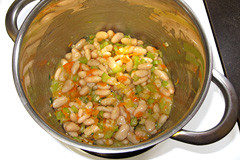
There are many ways to make Pasta e Fagioli, my favorite makes use a particular kind of small white beans called ‘cannellini’ and a short pasta called ‘ditalini’, ‘tubetti’, or ‘ditaloni’ (as in the featured picture). This recipe uses tomato sauce, but there are variations without it.

Pasta e Fagioli

Yield: 2 servings

Total Time: 45 minutes

Prep Time: 15 minutes

Cook Time: 30 minutes

Pasta e Fagioli

Ingredients

  • 1 small carrot
  • 1 stick of celery
  • 1 small onion
  • 2 cloves of garlic
  • 1 teaspoon finely chopped fresh rosemary
  • ½ cup crushed tomatoes
  • 1 can cannellini beans
  • 2 cups vegetable stock
  • Salt and pepper
  • 60 g ditalini pasta (3 handfuls)

Preparation

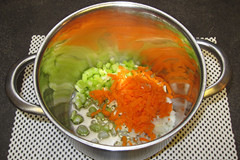
  1. Finely chop carrot, celery, onion, garlic and rosemary.
  2. Make a 'soffritto' (stir fry in olive oil, at medium heat, until tender).
  3. Add the cannellini (drained and rinsed).
  4. Add the crushed tomatoes and the vegetable stock; adjust salt and pepper.
  5. Simmer for ½ hr.
  6. Add the pasta and cook for another 10 minutes (or the time indicated on the box).
https://www.disgracesonthemenu.com/2010/12/pasta-e-fagioli.html

Breakfast or Colazione?

Breakfast in Italy is called ‘prima colazione’, or simply ‘colazione’. It’s the first meal of the day and many say it’s the most important one too. However, North Americans and Italians have fundamental differences of opinions in what to eat for breakfast. The first main difference is that savory breakfast items are almost absent in most parts of Italy. You would never see an Italian eating bacon and eggs, or even a bagel, which is standard in North America – and these items don’t appear on restaurant menus either. Things are quite different on the sweet side as well: no cereals, no peanut butter, no pancakes, no waffles or scones. What do Italians eat for breakfast then?

These are the components of a typical Italian breakfast: ‘caffè latte’ (hot milk with coffee) with a baked product, such as:

  • Bread or toast (with unsalted butter and jam, or just jam);
  • ‘Fette biscottate’ (called rusk in English) (also with butter and/or jam);
  • Pastries (e.g. croissants) or cakes (e.g. brioches);
  • ‘Biscotti’ (generic name for cookies, but more like the Italian version of cereal), typically ‘frollini’ (butter shortbreads), usually dipped in the caffè latte.

Hot chocolate or plain black tea (with milk or lemon) is sometimes an alternative to coffee. Other options that are generally reserved for young children include milk with barley or malt coffee substitutes, or milk with cocoa powder.

Italians follow more rules in general as to when to eat what. A cappuccino, for instance, is a morning treat, it’s OK in the afternoon as an alternative to espresso during coffee breaks, but it’s definitely not a replacement for the after-dinner espresso. Everything has a purpose, and the espresso after a meal is meant to be one last strong punch of flavor – the delicate nuances of a cappuccino would be out of place, and the milk would be heavy on a full stomach.

In Italy, a small selection of cereals with milk or yogurt cater to the diet-conscious but aren’t very common. Fruit juices are quite popular, especially pear, apricot, peach, and apple. With the exception of citrus, Italian-style juices are generally thicker compared to their North American equivalents, are also sold in individual glass bottles (20 ml), and are sometimes considered a complete meal. Fresh squeezed orange juice is also well-liked, especially during winter.

As you can see, sweet things are the preference. This is the case almost everywhere in Italy, with the Alto Adige region being the most notable exception. In Alto Adige, also called Südtirol, the Austrian influence can clearly be seen in the tradition of having cheese, ham, and eggs for breakfast.

A somewhat limited savory presence can also be found in hotels. Italian hotels generally just offer an expanded version of a home breakfast, but with the possible addition of a sample of cold cuts and cheese, in line with what is internationally known as Continental Breakfast.

A truly Italian routine, however, is to go have breakfast in what Italians call a “bar”. These have very little in common with North American bars. Italian bars are essentially licensed coffee shops that typically serve espresso all day, breakfast in the morning, sandwiches and beer around lunch time, appetizers (called ‘aperitivi’), and long drinks near dinner, and are usually closed in the evening. Bars are extremely popular in Italy – in the big cities you can find them at every corner, and they are all different from one another being usually privately owned (there are no major chains). Bars’ consistent quality, contained prices, and prompt service make them the preferred choice for people who commute to work or to school – it takes less time to get breakfast in a bar than it does to have it at home, and most Italians would also find it more satisfying. Prompt service however comes with a caveat. The busier the place, the more you should know what you want to order before you go in – you don’t want a “no cappuccino for you!” reaction from the bartender. Cash payment is also much preferred because of its speed. Then, after you get served, you are supposed to step aside and consume your breakfast quickly, trying not to exasperate the server and patrons behind you (the fact that it is your turn to be served doesn’t buy you all the time that you want to choose your pastry or dawdle in the bar). Most bars even encourage a quick turnover by having high tables and no sit-down service. You can read more on the Italian Bar in this article.

Bar-style breakfast consists almost exclusively of what the Italians call ‘cappuccino’ and ‘brioche’. We’ve already talked about cappuccino, and its alternatives such as ‘latte macchiato’ (with more milk), coffee ‘macchiato’ (with less milk), or just plain espresso (with no milk at all). By “brioche”, Italians actually mean any kind of baked good, the most common of which is in fact a croissant (‘cornetto’ in Italian) and almost never an actual brioche. A croissant can be “empty” (‘vuoto’), or filled (e.g. with ‘crema pasticcera’ -pastry cream-, apricot jam, chocolate cream, whipped cream, apple filling, almond filling, etc.). Other breakfast pastries which are also usually filled are: ‘fagottino’ (the equivalent of the French ‘pain au chocolat‘, when filled with chocolate), ‘sfogliatina’ (puff pastry pockets), ‘bombolone’ (also called with its German name ‘krapfen‘, the equivalent of a filled donut), ‘girelle’ (twirls) with raisins. Savory croissants, with optional ham and/or cheese, can also be found, but are definitely far less in vogue than the sweet versions. Other savory options are ‘pizzette’ (small puff pastry pizzas, usually with tomato and mozzarella), but are quite hard to find.

In Italy, the maximum price of the main bar menu items is regulated by the law. This makes it so all bars tend to charge the same maximum amounts allowed. While not competing on prices, bars still compete on quality. Pastry shops that are also cafés (called ‘bar pasticceria’) generally offer higher standards for baked goods, compared to regular ‘bars’; this is especially true in small towns. In big cities the bars with the higher customers turnover often get their pastries delivered fresh from pastry shops even multiple times a day and the quality of their baked goods is excellent. Smaller bars instead often bake their croissants themselves (from an industrially made base), and while smelling fantastic because of the onsite baking their croissants are not as good (and sometimes are thought of as more buttery and harder to digest). Still, smaller bars make good business in small towns where the competition is less, still providing a service to their customers.

In conclusion, breakfast is for the Italians a brief yet dear parenthesis in the morning. Even on weekends and holidays people generally don’t go out for sit-down breakfasts. In fact, there are no ‘all day breakfast’ places in Italy (though it’s definitely possible to have a cappuccino all day, it’s uncommon to see people have a croissant in the afternoon, so much so that bars tend to run out of pastries early and don’t replenish). As a result, breakfast in Italy is not necessarily a moment of social aggregation; it’s at most a meet-up point for 2 or 3 individuals.

The lack of savory options in the Italian breakfast also originates other interesting differences between Italy and North America. One difference is that for the Italians eggs are totally a lunch option (as the main or the second course). Another difference is that in Italy there is absolutely nothing like North American brunch; being the Italian breakfast so different from lunch, the two don’t mix: after sleeping in on weekends Italians may just decide to skip breakfast altogether and have their Sunday’s lasagna!

Eating Vegetarian

Italian cuisine, like many cuisines of the Mediterranean, is considered “vegetarian-friendly” because it features plenty of meatless dishes. Since not everybody has the same definition of “vegetarian,” let’s first clarify the terminology. By vegetarian dish, I mean a dish where no meat or fish in any form was ever used (so, no shrimp, no chicken broth, no anchovy paste), but where animal products may be involved (so, yes milk, eggs, honey). This type of vegetarianism is referred to as lacto-ovo, and it does include cheese made without using animal-derived rennet. For a list of Italian vegetarian cheese (updated to 2018), please download the pdf (courtesy of GreenMe).

North American cuisine tends to be very meat-centered, with the exception of some “vegetarian-heavy” cities (see here for a Top Ten list) where a higher percentage of vegetarians tends to live. In Italy, instead, a number of meatless dishes are fully part of everyone’s diet, and they can also be found in pretty much every restaurant. As a result, there aren’t many dedicated vegetarian restaurants in Italy (but you may find some in the big cities). Another consequence is that imitation meat is not as common as it is in North America – Italian people that become vegetarian generally have plenty of options and don’t need to resort to imitations.

One slight problem with vegetarian food in Italy is that it is sometimes hard to recognize which dishes are in fact vegetarian (and restaurants don’t help by generally not tagging vegetarian dishes on their menus). Italians don’t call a pasta dish “vegetarian,” they simply call it pasta al pomodoro, trenette al pesto, pasta alla Norma. Many pizzas are also vegetarian, but they go under the names of marinara, margherita (mozzarella is generally made without rennet), funghi (mushrooms), olive (olives). There is, however, one type of pizza explicitly called “vegetariana” or “ortolana”, which topped with grilled veggies.

As for the reasons why meat is not the main star of the show as it is in North America, a few theories can be made:

  • North America has a tradition of cattle ranching due to its vast prairies and veggies tend to be seen more as a side dish, something that you have to eat because it’s healthy, but that doesn’t add much to the flavor. There isn’t much tradition around vegetable preparations, and, in some cases, they are even considered more of a garnish that you don’t have to eat.
  • Italy, on the other hand, has a very different geography that makes cattle ranching more challenging. Also, the postwar years were especially tough, and meat hasn’t always been as available to everyone as it is nowadays. As a result, traditional cuisine naturally drifted towards using more produce and more starches.

But there may also be a more practical reason why produce is considered so differently: many of the vegetables grown in southern Europe are simply tastier than their North American counterparts. Possibly because of the favorable climate and soils, vegetables actually taste amazing! Better veggies make for more successful vegetarian dishes and, in an environment where the cuisine is centered on a few clean flavors and a handful of high-quality ingredients, interesting vegetables with complex flavor profiles simply claimed a central role in a number of dishes.

Unfortunately, Italian restaurants in North America tend to feature few, if any, meatless dishes on their menus. This is probably an adaptation of the expectation of the general public. Pizzerias tend to be more reliable in featuring at least a few vegetarian options.

Is Water Just Water?

Mineral water is extremely popular in Italy. The major brands of mineral waters are from specific springs, which are sometimes also renowned spas, and therefore have a precise location of origin.

But is mineral water just water? No, it also contains a unique mix of minerals and ions. Every spring is different, and the concentration of minerals can vary substantially across them. Most waters have mild diuretic properties or help digestion, but the composition of some makes them suitable as an aid in treating specific medical conditions. Waters that have low amounts of minerals (“oligominerali,” in Italian) are generally suitable for everyone, but those are under a low-sodium diet still need to pay special attention to the label (which by law must list the full composition.)

Most Italian waters that aren’t naturally carbonated are sold in two varieties: still (liscia -smooth, plain- or naturale -natural-) and sparkling (gassata -gasified, carbonated- or frizzante -fizzy-) where carbonation is artificially added. Rarely, spring water may have mild natural carbonation, generally also associated with higher amounts of minerals.

Most Italians have their own favorite brands of mineral waters. And even if they don’t, they certainly have a strong preference on whether they like still water or sparkling water. Carbonated drinks, in general, are obtained by adding pressurized CO2, which partly combines with water to form Carbonic Acid (H2CO3). H2CO3 is a weak, unstable acid that spontaneously separates back into CO2 and water when at atmospheric pressure and room temperature. The tingling sensation that comes from drinking sparkling water is caused by the formation of bubbles as well as because a small amount of H2CO3 is still dissolved and gives a slight burning sensation. That’s why carbonated mineral water has more flavor than still mineral water from the same spring.

Still mineral water aisle in an Italian supermarket

All mineral water is subject to a mandatory bacterial analysis and certification from a reputable university. As for the bottle, PET is becoming more popular, but glass bottles are still used and preferred for carbonated water because the carbonation can slowly escape from porous PET. In either case, the empties are usually returned to the store where the water was bought, either to be recycled or -in the case of glass bottles- returned to the manufacturers to be reused (washed, sanitized, refilled, and re-labeled).

Even though Italian tap water is suitable for drinking and has good flavor in most areas, it’s more common for households to consume bottled mineral water. This is because of a few different reasons: 1) A good portion of Italians like carbonated over still and home carbonation systems are not very common; 2) There is definitely more appeal for a bottled water certified to come from a natural spring in the mountains than for tap water from decades-old city pipes that has stagnated in a distribution tank; 3) Mineral water is relatively inexpensive in Italy and, because of its popularity, is easy to find and convenient home delivery is often available.

Unlike in North America, restaurants don’t offer complimentary iced tap water. You can ask for it, but normally people order bottled mineral water, sparkling or not. However, by law, every bar and café open to the public has to offer a glass of tap water if requested, even to non-customers.

Imported bottled water is becoming more and more popular in North America, usually in its sparkling version. And since it’s imported water, which was even bottled in Italy, Italian mineral water can be quite expensive. The market is increasing not only because of the appeal of a novelty but also because carbonated mineral water is a zero-calorie option that tastes better than soda water and actually pairs up with food. There are even mineral water tasting classes which give the qualification of Idrosommelier.

To enjoy properly, mineral water should be served chilled and, optionally, with a lemon slice. Ice should be avoided since, as it melts, it would dilute the dissolved minerals as well as the carbonation. Sparkling water is also best from a bottle that has just been opened since the cap causes the pressure from released CO2 to build up, in turn preventing more CO2 from being produced, thus preserving the carbonation.

“Italian” Dressing?

Italian dressing. Obviously you can’t find such a thing in Italy, exactly like you’ll hardly find anything called “Chinese food” in China. But it isn’t just the name that doesn’t exist, Italians don’t even know the concept of a (premixed) dressing that you can buy in a store.

The main reason why Italians don’t buy any bottled dressing is that there is only one really popular salad dressing – a simple mix of oil and vinegar, plus salt. Now, oil and vinegar don’t actually mix… and that is probably another reason why there is no “Italian dressing” in a bottle: it would look gross!

So, how does mixing of oil and vinegar work? They are applied separately; it’s recommended that vinegar and salt go on first (salt dissolves in vinegar, and doesn’t in oil – some people even premix salt and vinegar in a tablespoon before adding it to the salad), then after a quick toss olive oil is added on, just enough to lightly coat the greens and enhance their flavor.

Now, what kind of oil and vinegar? A light olive oil (e.g. a delicate extra-virgin from Tuscany or Liguria, or a less flavorful non extra-virgin olive oil) is generally preferred on delicate greens (such as lettuce). Vegetable oils can also be used. For stronger greens (such as arugula) a fruity and aromatic extra-virgin is instead recommended. As for the vinegar, regular red wine or white wine vinegars are the most common, but balsamic vinegar is becoming more and more popular. Balsamic vinegar originates in the regions surrounding the cities of Modena and Reggio Emilia. It’s now also made elsewhere, but the one produced in Modena and Reggio Emilia is certified as Protected Designation of Origin, and guaranteed to be made using traditional methods. As an alternative to vinegar, lemon or other citrus can be used to add acidity.

Instead of bottled dressing, households always have oil, vinegar, salt and pepper on the table as, generally speaking, people prefer to dress their own salad themselves. The same goes for restaurants and cafeterias – oil and vinegar are brought to the table whenever a salad is ordered and the waiters never ask what kind of dressing the customer would like.

Typical leafy greens used in Italian salads are lettuce and its variants (Romain, lamb’s lettuce or ‘soncino’), endive, spinach, arugula (a.k.a. rocket), radicchio , chicory, cabbage. Other vegetables commonly used are sliced tomatoes, cucumbers and peppers (with optional onions), fennel, any kinds of cooked and chilled beans, chilled boiled potatoes and green beans.

Italians love their salads, but they normally have them only as a side to the second course (which is normally meat or fish), or at most as an appetizer. Unlike in North America, salad is never served as a side to a pasta or rice dish. Lately, “big salads” (‘insalatone’) have become a popular lunch choice, they usually have some leafy greens with a combination or all of the following: corn, canned tuna, hard-boiled egg slices, ham, cheese dices (e.g. Fontina or Swiss). Big salads’ dressing is normally the usual oil and vinegar, or just oil.

There is absolutely no Caesar salad in Italy.

Formaggio – An Introduction to the Many Varieties of Italian Cheese

Even though Italy is a pretty small place, its regions are quite different from one another. And cheese (formaggio , in Italian) is one of the products that changes the most across the territories. Since the area of origin is a big part of what defines each cheese’s properties, many Italian cheeses have a protected denomination under European Union law (PDO – “Protected Designtrecciation of Origin”, or DOP – “Denominazione di Origine Protetta” in Italian). For a cheese to be labeled as PDO, every step of its production needs to happen in a specified geographic area: from local cows eating local hay, through production happening entirely in local facilities, to aging (or, for fresh cheeses, just packing) occurring rigorously in place.

Since Italian cheese names are so representative, in Italy they are never used as adjectives. For instance, you just say Mozzarella , not formaggio Mozzarella. And this even when the cheese name is indeed an adjective (for instance in the case of Parmesan which means ‘from the city of Parma’ – in Italian you just say Parmigiano , in English Parmesan cheese is instead more common). It has to be noted, however, that the name alone doesn’t guarantee the origin. For instance, “Mozzarella” isn’t a PDO cheese per se, while Mozzarella di Bufala Campana is (http://www.mozzarelladop.it/).

Specialized cheese stores in North America can provide a good sampling of the most important cheeses found all around Italy. However, even the best stores are incapable of handling fresh cheeses (some need to be consumed within 3-4 days from their preparation), and locally made equivalents are sometimes sold instead (although, generally, they don’t compare with the originals).

Cheese is considered very highly in Italy. Italians are very proud of and take their cheeses very seriously. They use them in their cuisine, but mostly eat them on their own, just with some bread or accompanied by fruit (pears, grapes), by compotes (figs), or kinds of honey. All aged cheeses go very well with wine. Often, cheese is a course on its own (served at the end of the meal, before fruit or dessert). Eating Italian cheese is a true multi-sensorial experience, from the look, to the aroma, to the deeply multi-faced flavor. And, with the many varieties found from north to south, cheese is also a fascinating journey, both geographically and historically.

Let’s go over the main Italian cheeses, classifying them by the process used to make them.

Formaggi a Pasta Cruda (Uncooked Cheeses)

Fast ripening (less than 30 days):

  • Caciotta (e.g. Caciotta Toscana DOP) –usually a blend of ewe (70%) and cow (30%)– traditional creamy farmhouse cheese.
  • Mascarpone –cow– one of the main ingredients of Tiramisù , also used in other preparations as an alternative to heavy cream or butter.
  • Stracchino –cow– gets its name from the word ‘tired’ (in Lombard dialect: stracco), referring to the fact that used to be made from the milk of cows who were tired because of the transhumance to the valley after the alpine summer.
  • Caprino –goat– an aged version also exists.

Medium ripening (1-6 months):

  • Bel Paese (trademark) –cow-.
  • Taleggio (PDO, Taleggio Valley, Lombardy) –cow– [pronounced “ta’leddʒo”, not “ta’lejeeo”!] when very young, tastes similar to Bel Paese.
  • Gorgonzola (PDO, Lombardy) –normally, cow– soft and creamy if is less than 2 months aged, crumbly and spicy-hot when aged for longer.

Formaggi a Pasta Semicotta (Semi-cooked Cheeses)

Medium ripening (1-6 months):

  • Fontina (PDO, Aosta Valley) –cow– soft when younger, harder and more pungent when aged. Differs from Danish fontina which has a red wax rind.
  • Asiago (PDO, Veneto region) –cow– great on its own as a table cheese, can be used on pasta (grated or in slivers).
  • Montasio (PDO, Friuli and Veneto regions) –cow– also consumed on its own or added as an ingredient to several dishes.
  • Piave (trademark, Veneto region) –cow– mostly a table cheese, three varieties are produced: mezzano (medium aged), vecchio (old), and stravecchio (extra-old).

Formaggi a Pasta Cotta (Cooked Cheeses)

Slow ripening (more than 9 months):

  • Grana Padano (PDO, northen Italy) –cow– considered inferior to Parmigiano Reggiano because aged less (9 months minimum) and produced with less strict quality regulations.
  • Parmigiano Reggiano (PDO, Provinces of Parma, Reggio Emilia, Modena, Bologna, Mantua) –cow-, one of the most representative Italian cheeses in the world – its origins can be traced back to the middle ages and the recipe hasn’t changed substantially (this cheese is aged at least 12 months and up to 30). It’s eaten on its own or used as a complement to hundreds of recipes, most pasta dishes, and risottos.
  • Aged Pecorino – (4 varieties of PDO: Sardo, Romano, Toscano, Siciliano from the corresponding regions) –sheep– a mildly aged variety also exists.

Formaggi a Pasta Filata (Spun Paste Cheeses)

Fast ripening:

  • Mozzarella –cow, water buffalo– can be made of cow milk, but the one made of water buffalo milk is more renowned and “Mozzarella di Bufala Campana” is PDO. Small sized mozzarellas, usually with high water content are called bocconcini. Similar products are fior di latte and Treccia.
  • Scamorza (from the Naples area) –cow– both smoked and mild varieties are used for instance on pizza and with pasta.
  • Burrata (also from southern Italy) –cow or water buffalo- mozzarella on the outside and cream plus mozzarella on the inside. Eaten as is at room temperature is a true delicacy.

Medium ripening (1 month):

  • Caciocavallo (southern Italy, e.g. PDO Caciocavallo Silano) –sheep, cow– a smoked variety also exists.
  • Provolone (e.g. PDO “Provolone Val Padana”) –cow– [pronounced provolone-eh!] originated in the south but is now produced mostly in northern Italy.

One characteristic of Italian cheeses that definitely stands out in North America is that they often have some kind of moldy rinds. In general, the rinds are not meant to be eaten (with a few exceptions, e.g. scamorza and provola which have edible rinds), but they are essential for the aging process. Italian stores, whenever possible, try to keep the cheese wheels whole and only slice them to order (this is especially true for fresh or medium ripened cheese; aged cheese gets more “stable” and better maintains its properties when stored).

Even though Italy is a big producer of cheese, a few foreign brands managed to make their way into the Italian cheese market, with moderate success. For instance, in 1971 the American Kraft introduced Philadelphia, a pre-packed cream cheese, and in 1975 a type of cottage cheese (sold under the brand name “Jocca”). Kraft also introduced a kind of processed cheese slices called “Sottilette” (Italian for “thins”). It has to be noted that the words “cottage cheese” and “cream cheese” don’t even exist in Italian, let alone “processed cheese” – these products are exclusively known by their brand names (to Kraft’s advantage).

Espresso Myths

What’s Espresso?

Espresso is what you get if you order a coffee (‘un caffè’) in any Italian café (or ‘Bar’ as Italians call them). Home-made coffee generally isn’t espresso, it’s a short coffee made with a stove-top machine called ‘Caffettiera’ (either ‘Moka’ or ‘Napoletana’). More recently, however, electric espresso machines have appeared in many Italian households.

Italians truly love their coffee and enjoy it several times a day: for breakfast (usually in the form of a ‘Cappuccino’, see below), at break, after lunch, and after dinner. However, most Italians drink single shots – saving the double (or ‘doppio’) for “extreme needs” to wake up (though these days people probably prefer energy drinks). In North America, double is more common.

The difference between an espresso and a coffee made with a Moka is the fact that an espresso machine quickly squeezes pressurized hot water through compressed finely ground coffee, whereas a Moka gently pushes the water through a smaller quantity of mildly compressed coffee. The difference made by the espresso maker is in the remarkable added creaminess and intensity.

Most Italians take their coffees with one or two teaspoons of sugar, some add cold milk or cream. If you add steamed milk to espresso, you get a Caffè Macchiato (not a Machiatto) – which literally means marked or stained coffee (coffee marked/stained with milk). If you add more steamed milk, you get a Cappuccino (not a Capuccino) – which literally means small cap. If you instead add espresso to a glass of steamed milk, then you get a ‘Latte Macchiato’ – which means marked/stained milk (milk marked/stained with coffee). ‘Caffè Latte’ is instead normally any warm milk (including steamed) with any type of coffee (including the regular home-style coffee). ‘Latte’ alone in Italy simply means cold milk.

Espresso Fails

Now, let’s focus on what can go wrong outside of Italy. Here are a few hints that your espresso experience is likely not going to be authentic:
1) If you enter a café, order an espresso, and the attendant (or ‘Barista’) asks you: “For here or to go?”
2) If you hear the attendant operate the grinder dispenser lever more than once for a single or twice for a double (or for two singles).
3) If you get your espresso cup filled up to the top.
4) If your espresso is lukewarm.
5) If your cappuccino is extra hot and the foam is heaping.

Here are some explanations:
1) Nobody in Italy would ask you if you want your espresso “to go”. Espresso to go exists served in special cups with a lid, but it’s very uncommon. An espresso takes 5 minutes at most to drink, generally while standing at the bar and would get cold if consumed any later.
2) The grinder has a dispenser that produces the exact amount of coffee for a single shot. Since quantity is extremely important for the end result, it’s not something that you want to mess with (too much coffee would give a thick cream that would come out so slowly to get cold before you have a chance to drink it; too little coffee would give a lighter tasting coffee without any creaminess). The dispenser operates correctly only when filled with freshly ground coffee; if almost empty, then you’ll have to bang on the lever to get every last bit out, losing control of the quantity.
3) Espresso cups are small, but this doesn’t mean that they have to be filled up to the rim. Perhaps, in North America, the customers might complain saying that they paid for a full cup, but about half is what Italians expect. Espresso cups are either made of thick ceramic and preheated, or thin ceramic, or even glass.
4) Properly made espresso (e.g. in preheated cups) is very hot.
5) ‘Cappuccino’ in Italy is normally not served as hot since the microfoam insulates the drink from the environment, keeping it at the right, sipping temperature. Proper cappuccino foam has small bubbles and looks like cream, not like beaten egg whites!

Preface

I was born in Italy and I have been living in Vancouver, Canada for the last 10 years. I love Vancouver and I love eating out in Vancouver, but I can’t help but notice the many distortions of Italian dishes on restaurants menus.

For some reason that I don’t understand, in Vancouver Italian food is almost as common to find as it is to find sushi. And it isn’t just because of the many (more or less authentic) Italian restaurants, west coast restaurants, and even chains often like to feature Italian dishes as part of their regular menus.

If on one hand, I’m flattered for all this attention, on the other hand, I’m seriously worried that the authentic Italian cuisine might get undermined by all these unsuccessful imitations; that people will either decide that they don’t like Italian food or -worse- that they like the imitation better than the real thing, and would turn the latter away. Frightening!

Even just on spelling and pronunciation, I understand that some Italian words will get Americanized (e.g. ‘Parmesan’ cheese), but I don’t understand why people can’t do an Italian spell check or even just a Google search before printing out their menus (it’s ‘focaccia’, not ‘foccacia’!) Maybe I’m hyper-sensitive to the issue because Italians don’t make many spelling mistakes (the Italian language is written pretty much exactly like it’s pronounced), but this makes Italian spelling mistakes stand out even more.

In this blog, I’m very pretentiously trying to fix the problem. I will say the proper ways to write the names of Italian dishes. And, from what I know, I will also try to say how the dish should look and taste… for sure I will say how the dish most definitely *shouldn’t* look or taste 🙂